Leeds Professor part of international team monitoring Manhattan-sized glacier break

An international research team including Leeds Professor has reported a major calving event in Greenland, marking the glacier's largest loss of floating ice since 2012.
The 76.4 km² ice island broke away from Petermann Glacier in Northwest Greenland on 4 August 2026, making it the largest Arctic calving event since 2020. Calving events are when a large chunk of ice breaks off from a glacier.
The research group, which includes University of Leeds’ Professor Anna Hogg, Dr Benjamin Wallis and postgraduate researcher Molly Hammond warn that two further large calving events are likely in the near future as fractures continue to develop across the glacier's floating ice tongue.
Manhattan-sized iceberg
The newly formed tabular iceberg is estimated to be up to 150 metres thick and has a surface area comparable to Manhattan Island. Scientists say it provides a rare opportunity to study how large Arctic ice masses form, drift and break apart over time.
The event was identified by Adam Garbo, a PhD student in glaciology at the University of Ottawa, through ongoing international collaboration involving researchers from the University of Ottawa, the University of Stirling, Environment and Climate Change Canada, Lancaster University and the University of Leeds.
Years of monitoring reveal growing instability
The calving event follows years of satellite monitoring as part of the research that has monitored changes in the Petermann Glacier since 2019. Researchers have documented the development of fractures within the glacier's floating ice tongue and observed increasing signs of instability over several years.
Adam Garbo said:
Petermann Glacier has long been one of Greenland's largest remaining ice tongues. We've anticipated this break for years, and seeing it finally happen is remarkable.
Satellite imagery from the European Space Agency's Sentinel-1 mission showed significant deterioration along the centreline of the ice tongue on 3 August. By 4 August, the new ice island had detached from the eastern side of the glacier.
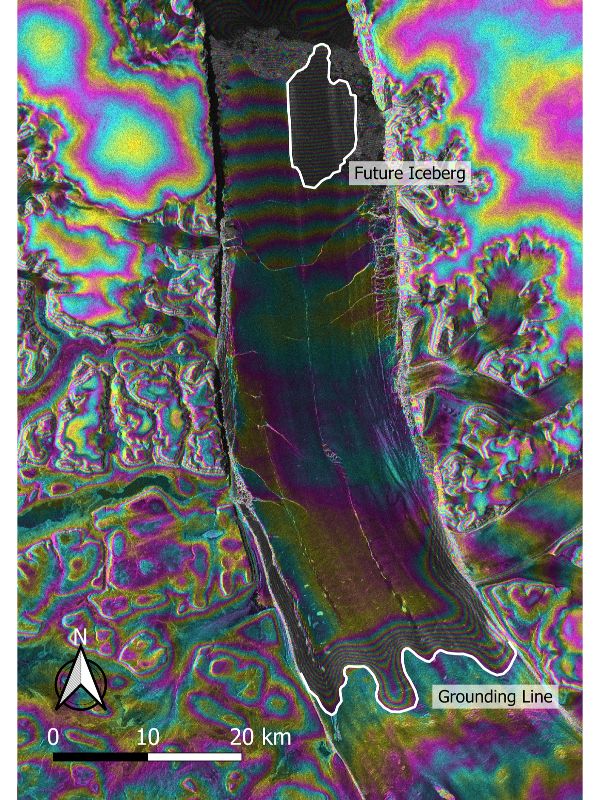
Interferogram over Petermann Glacier produced in April using InSAR. Fringes correspond to deformation, and clearly highlight the area that has become the iceberg, months before it detached
Valuable insight into a changing Arctic
While large tabular icebergs are frequently observed around Antarctica, similarly sized Arctic ice islands are much rarer. Because they can survive for years, they provide an important opportunity to investigate glacier retreat, ocean conditions and the evolving dynamics of polar environments.
Dr Benjamin Wallis of the research team said,
“Calving events this large are infrequent in the Arctic. Since the last major calving event at Peterman Glacier in 2012, our capabilities to observe, track and study them from space have improved significantly, thanks to new satellite missions from the European Space Agency and NASA.
We hope this iceberg will stimulate more research and give us lots of great opportunities for new insights into ice and ocean processes.
Researchers believe the recent calving event is unlikely to be the last. Two additional large ice islands are expected to detach in future as existing rifts continue to spread across the ice tongue.
If all three ice islands break away, the Petermann ice tongue would shrink by around 254 km², representing a reduction of approximately 22%.
Supporting Arctic navigation and safety
Beyond its scientific significance, the new ice island presents important challenges for Arctic navigation and offshore operations.
Environment and Climate Change Canada is monitoring the ice island's movement and assessing any risks it may pose to shipping routes and infrastructure. These large ice masses can drift for years before fragmenting into smaller pieces that are more difficult to track.
Dr Abigail Dalton of the Canadian Ice Service, Environment and Climate Change Canada, said:
These are thick blocks of ice that can drift for years. Over time, they fracture into smaller, harder-to-track pieces that pose hazards to vessels and resource operations.
The research team will continue to monitor the ice island using satellite imagery, aerial observations and tracking data. Their work aims to improve understanding of the processes driving the calving and retreat of Arctic ice shelves and the wider impacts of climate change in polar regions.
Further information
Read more about the research being conducted on land and sea ice in the arctic:
Main image credit: Sentinel-1(2) Image courtesy of the European Commission Copernicus programme and the European Space Agency