Beavers help reduce flood risk and boost nature in Yorkshire trial

Releasing beavers as part of a trial in the North York Moors has helped to reduce downstream flooding and enhance biodiversity, according to new research from the University of Leeds.
Two beavers were released in 2019 into an enclosure in Cropton Forest, where natural flood management had already taken place to try to reduce the flood risk to villages downstream. The trial was led by Forestry England and licensed by Natural England.
Researchers worked with volunteers to take comprehensive measurements at the site before the beavers’ release and then monitored their impact over a five year period. The results are published in the academic journal Ecohydrology.
The site was transformed by the beavers in ways we never imagined.
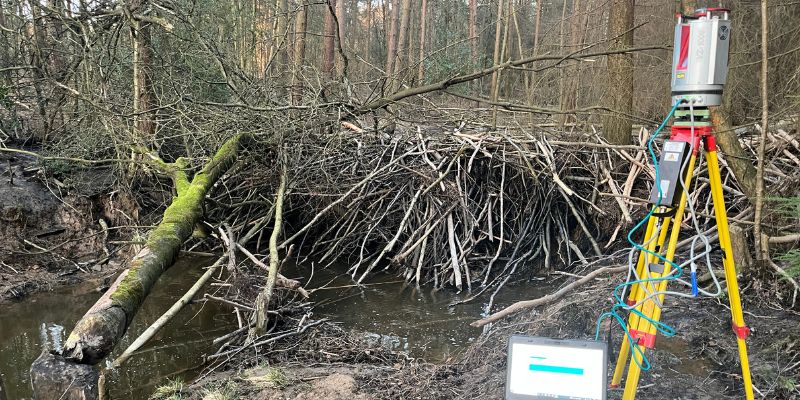
Over the five years, the beavers constructed six dams, one of which was the biggest in England. The beavers’ efforts augmented the impact of existing natural flood management infrastructure, leading to lower peak flows in the river, which were slower to arrive downstream and contained smaller volumes of water.
Aquatic plant diversity increased, and fish and amphibian species richness were higher than in a neighbouring stream. The researchers also found evidence of an increase in bat populations at locations and times that corresponded with beaver activity.
Lead author Professor Mark Smith, from the School of Geography, said: “This is the first time so many different things have been measured at the same site, including before and after beaver release comparisons. The site was transformed by the beavers in ways we never imagined.
“We saw peak flow reductions, increased drought tolerance and increases in plant diversity and in vertebrates, such as mammals, amphibians and dragonflies.”
Beavers have been absent from the British landscape for centuries, but wild beaver populations have returned in recent years as part of reintroduction schemes, including releases into monitored enclosures.
The Eurasian beavers from Tayside in Scotland were released into the enclosure at Cropton Forest in April 2019. They were already a pair, and 11 kits were born in the enclosure over the trial period. To manage the population, four older juveniles were relocated to support other projects across England. Camera trap footage revealed that the beavers lived in an extended family group with just one dominant breeding pair. All beavers were observed using the whole site.
Complex wetland habitat
The beavers built four large lodges (homes) during the five-year trial. The initial lodge was at the upstream end, with a second at the downstream end in 2022, and more recently, two further lodges in the centre.
Initially, the beavers did not incorporate the existing natural flood relief infrastructure into their dams. The human-built dams degraded and lost over half of their storage capacity during the trial, but the additional capacity provided by beaver dams compensated for this. There are now signs of beavers restoring and extending the active life of these degraded human-built dams.
Species recovery Officer for Forestry England in Yorkshire, Cath Bashford, said: “Being closely involved in bringing the beaver back to Yorkshire for the first time in several hundred years has been incredible.
“It has been amazing to watch the changes that the beavers have made to the site throughout the trial and the species that have moved in and thrived alongside them. They have created a complex wetland habitat connecting the river with the floodplain, holding back water in the upper catchment, bringing benefits in times of drought and slowing the flow in times of flood.”
Research co-author Dr Megan Klaar of Leeds’ School of Geography, added: “Our monitoring clearly demonstrates the profound and interconnected impacts beavers have on water flow, the terrain and biodiversity.
“Comprehensive scientific evidence is especially relevant given the UK government’s commitment to reintroducing beavers into the wild.”
Following the success of the trial, Natural England has extended the licence until 2029, and research onsite will continue to gather evidence for potential future wild releases.
Further information
The research was funded by the Natural Environment Research Council and carried out by School of Geography and Water@Leeds, University of Leeds; Centre for Resilience in Environment, Water and Waste (CREWW), University of Exeter; Forest Research; Aquatic Ecosystems Group, UK Centre for Ecology & Hydrology; School of Health and Life Sciences, Teesside University; Yorkshire Mammal Group; Forestry England; Yorkshire Dragonfly Group; School of Natural Sciences, University of Hull.
For media enquiries, please contact Kersti Mitchell via k.mitchell@leeds.ac.uk.