Trial shows e-cargo bikes can replace cars

A major trial of e-cargo bikes which saw dozens of families use them for shopping, leisure and commuting shows they have the potential to reduce car use and improve health, say researchers.
Over half of all mileage ridden during the month-long trials in Leeds, Brighton and Oxford replaced car trips, and after the trial 20% of the participants went on to buy an e-cargo bike.
Researchers from the Institute for Transport Studies at the University of Leeds who led the ELEVATE (Electric Vehicles for Active and Digital Travel) trials are now calling for them to be rolled out elsewhere. The findings of their study “E-liveable – unlocking the potential of electric micromobility through e-bikes, e-cargo bikes and e-scooters" are published today. (Thursday 4 June)
Lead researcher, Dr Ian Philips from the University of Leeds Institute for Transport Studies, said: “The ELEVATE project shows that e‑micromobility—especially e‑bikes and e‑cargo bikes—has significant untapped potential to reduce car use, improve health, and enhance everyday life beyond large cities.
“But realising this potential will require coordinated action by policymakers around promotion, affordability, infrastructure, safety and regulation, rather than relying on individual behaviour change alone.”
The trials involved 49 households in suburban areas of Brighton, Leeds and Oxford who were offered the free use of an e-cargo bike for one month. Participants were offered training and were provided with accessories such as child seats.
It's been an overwhelmingly positive response.
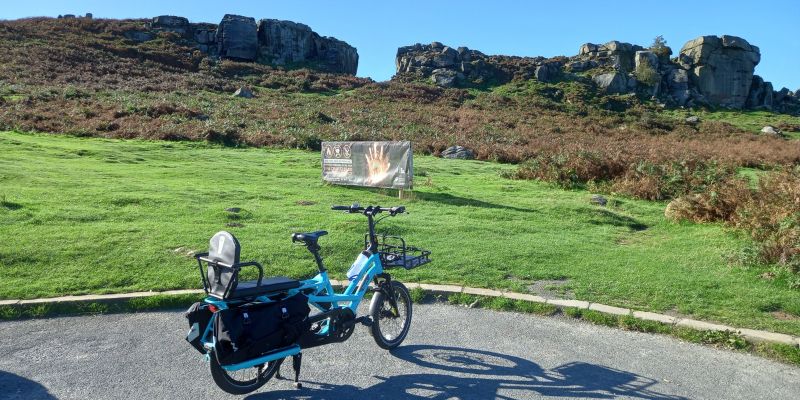
Two types of household e-cargo bikes were used during the trials: long johns with a cargo /passenger area at the front, and longtail with a long rack at the back for panniers and child seats. The trials’ impact was assessed using interviews with participants, along with travel diaries, GPS tracking data for bikes, and car mileage records.
The research found:
- Participants used e-cargo bikes for a wide range of purposes, most commonly to escort children to education, and for shopping and commuting, travelling an average of 38-42km per week.
- Over half of the e-cargo bike mileage ridden during trials was a substitute for car use.
- After the trial 20% of participants went on to buy an e-cargo bike – showing that ‘try before you buy’ schemes encourage longer term take up.
“I absolutely love it”
Adam, a participant in the Leeds trial, said: “The benefits of this have been transporting the kids - the fact that I can put them in there with all their bags from whatever they’re doing, whether it’s nursery, taking them to a friend’s house or taking them to a sports club, I can get it all in. It’s perfect for local journeys, I absolutely love it.
“Riding on this, I feel people do give you a lot of space compared to when I’m in Lycra on my road bike. When somebody sees that it’s a bloke stood upright with two kids in the front clearly doing a chore rather than a pleasure ride, I think people do give you more space and patience.”
Ali, who also took part in the Leeds trial, added: “When I’ve been riding past pubs, I have had people cheering for me, which is totally random, but that's happened maybe three or four times.
“I’ve also had people stopping and smiling and waving, people just interested, people wanting to have a look at the bike, wanting to ask questions about it, such as does it have a motor, how heavy is it, do the girls like it? It's been an overwhelmingly positive response.”
The trials also revealed some of the barriers to more widespread use of the bikes, including purchase costs; theft; negative perceptions of battery safety; confusion over which vehicles are legal; and a lack of appropriate infrastructure such as charging stations and parking facilities.
In addition to the e-cargo bike trials, the researchers commissioned a national survey of 2,000 people in England, conducted by YouGov. The results showed that over half would like to try using an e-bike, e-cargo bike or e-scooter.
Further information
Top image: Participant Adam and his kids using the e-cargo bike.
“E-liveable – unlocking the potential of electric micromobility through e-bikes, e-cargo bikes and e-scooters" is published today (4 June).
The ELEVATE project is led by the University of Leeds, in collaboration with the University of Oxford, University of Brighton, Technical University of Dortmund and Technical University of Eindhoven. It is funded by the Engineering and Physical Sciences Research Council, grant reference UKRI EP/S030700/1.